

Kamangiri: A Forgotten Art Speaks Again
Nikhil & Bhagyashree, House of Kutch Studio, Pragmahal, Bhuj March 2026

What began as an exploration of architecture soon became a deeper search for stories not written in books, but painted across quiet corridors and fading lime walls.
In the course of our fieldwork across Kutch, we encountered a mural tradition that once thrived but has now nearly disappeared from public memory. This is Kamangiri, a visual storytelling practice that once adorned the walls of merchant homes, palaces, and public buildings between the mid-18th and early 20th century.
Where We Found It
Our search led us to places that most people have never heard of, and a few that everyone in Kutch knows, but has never looked at closely enough.
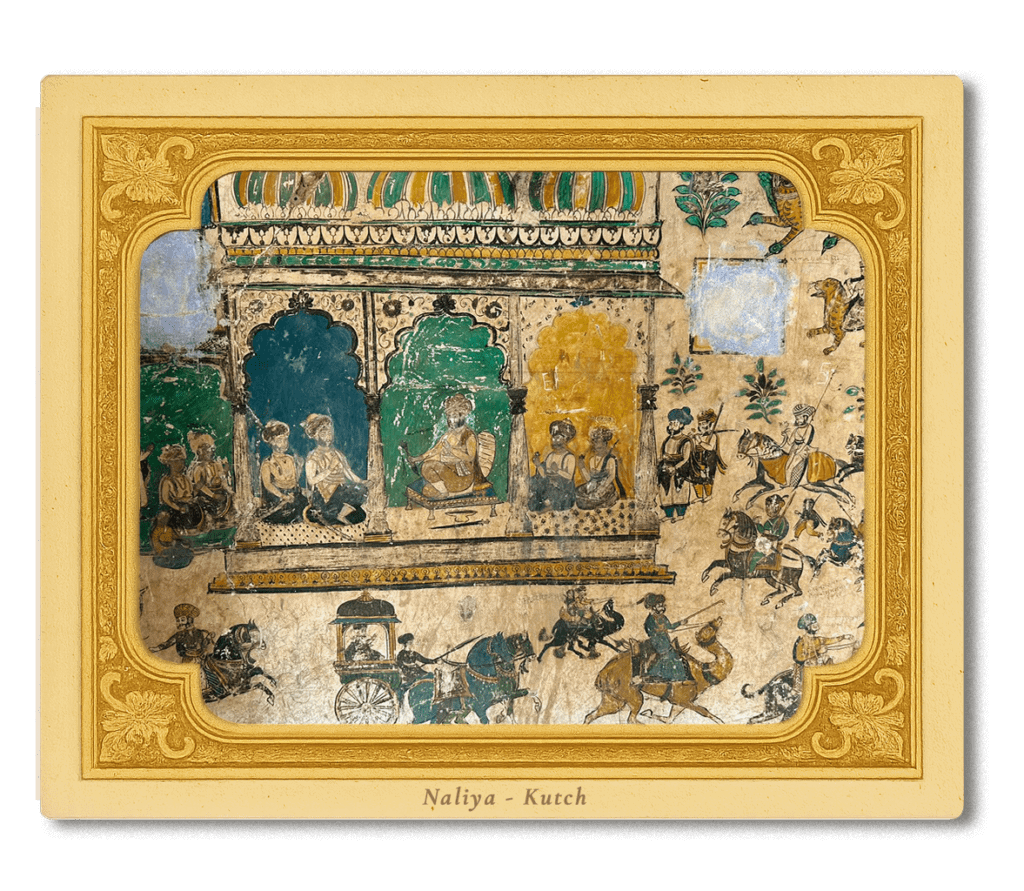
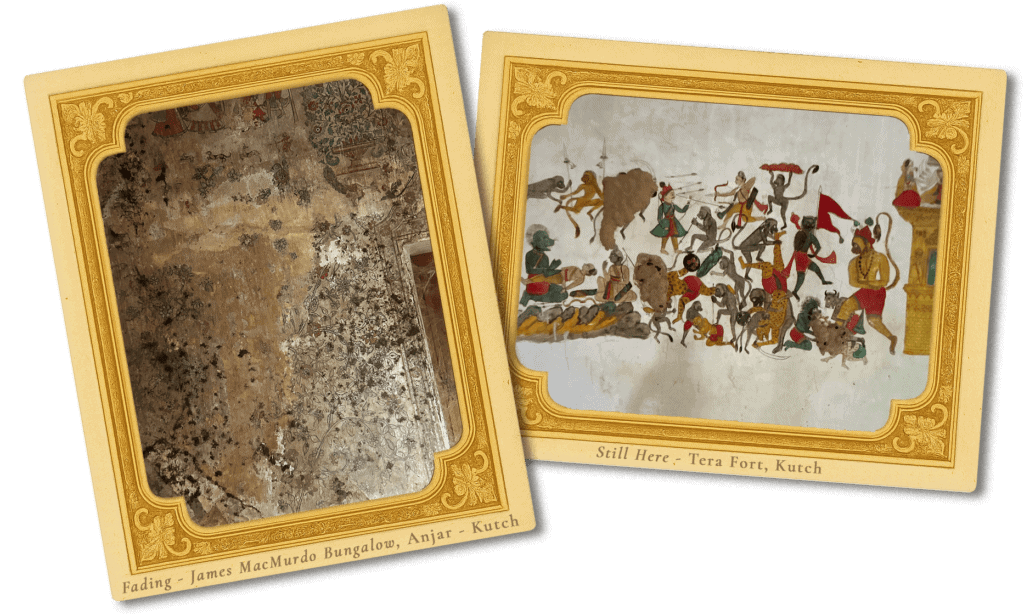
On 22 November 2023, we documented the James MacMurdo Bungalow in Anjar, a colonial-era residence that carries some of the most delicate Kamangiri we have encountered. Dense scrolling vines, crimson and green flowers, an entire wall turned into a living garden. It is extraordinary that it still survives.
On 17 May 2024, we visited Kalubha Waghela's House in Mundra. Here, a large narrative scene depicts figures gathered around a pavilion on what appears to be a steamship, traders, musicians, attendants, the world of a prosperous merchant family captured with bold lines and vivid colour. This painting alone tells you more about 19th century Kutch than most history books.
On 10 October 2024, we documented the Darbargadh at Naliya, walls covered in hunting scenes, horsemen, mythological figures, and animals, rendered with the bold outlines and flat colour characteristic of Kamangiri. These are among the more vivid examples we have encountered in our research, a reminder of how completely this tradition once lived within the spaces of daily life and royal patronage across Kutch.
On 19 October 2024, we returned to Tera Fort, a place that has been central to our research from the beginning. The Kamangiri inside the fort's interior spaces is among the best-preserved we have documented. The Ramayana scenes, the figures, the painted borders, these walls are among the last places where Kamangiri survives in something close to its original form.
These are four documented visits among many. The research is ongoing.
Many of the places we have documented are now slowly deteriorating. Walls are cracking. Plaster is falling. Buildings that once carried these paintings are being left to decay or lost to demolition. What we have photographed in some cases may already look different today or may no longer exist at all. Without documentation, awareness, and active care, Kamangiri will survive only in books and photographs, visible but no longer alive.
We are doing what we can, documenting as carefully and as quickly as possible, sharing what we find, and reviving the practice in the studio so the knowledge of the material does not disappear entirely. These walls deserve to be seen, understood, and protected. We are working towards that, for the generations who will come after us and deserve to know this art not just from images, but from the walls themselves.

The Makers Behind
the Art
The Makers Behind the Art
To understand Kamangiri, you have to understand who the Kamangars were, because the art cannot be separated from the people who made it.
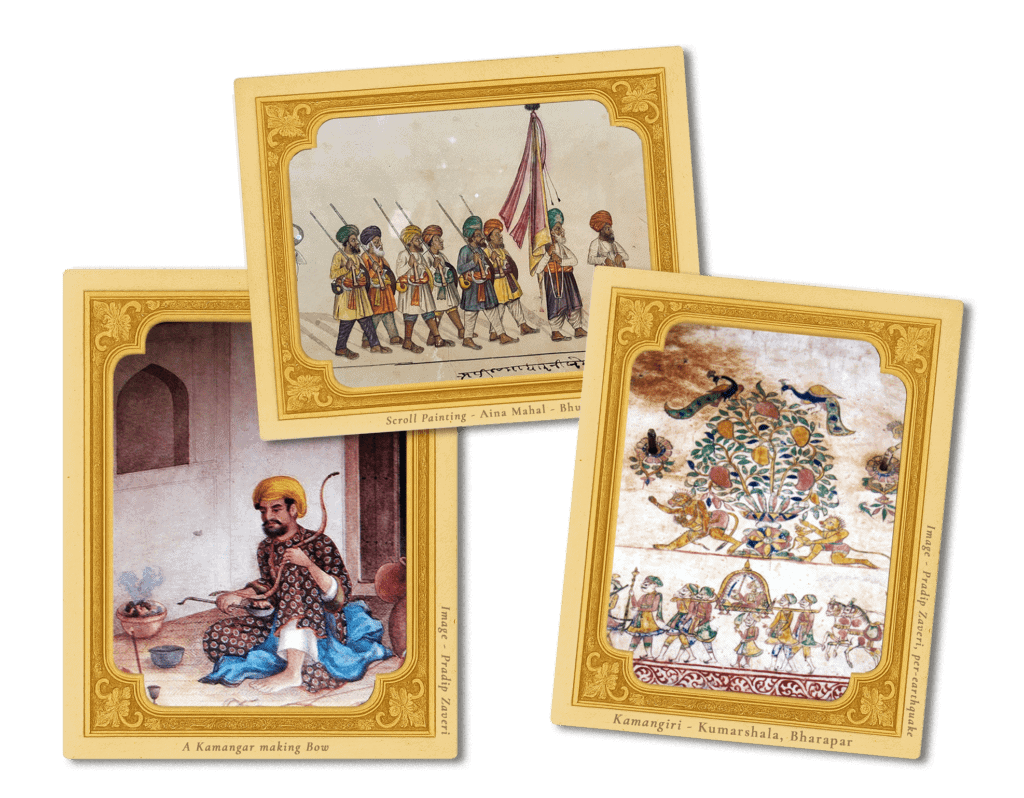
From our own research and from narratives we gathered across Kutch, the Kamangars were skilled artisans of the royal courts, known for making and decorating bows, shields, and ceremonial arms. The word Kamangar itself likely derives from the Persian kaman, meaning bow, which reflects these origins.
Over time, this sensibility moved from the weapons in their hands to the walls around them. They began painting the interiors of merchant homes, havelis, and royal estates. Some narratives from Kutch suggest that the Kamangars were originally from a Muslim background, though over time other communities also began practising Kamangiri, as often happens with living craft traditions, the art gradually moved beyond the community that originated it.
What is particularly notable, from what we have documented, is that much of the patronage for Kamangiri came from wealthy Bhatia and Jain merchant families, who considered these murals auspicious. A Muslim craft tradition, commissioned and celebrated by Hindu and Jain patrons, painted across the walls of their most private spaces. This crossing of community and faith through art is one of the most quietly remarkable aspects of Kamangiri, and one that we feel is important to acknowledge.
Their paintings travelled beyond walls too, onto scrolls commissioned for palace halls. The Kamangar was always, at heart, a maker of beautiful surfaces. The wall was simply a larger canvas.
What Kamangiri Is
Kamangiri is not a school of art. There is no defined style or written code. It is a tradition passed through hands, shaped by place and patronage.
Sometimes it told stories from Jain cosmology. Sometimes the Ramayana or Krishna Leela. Other times it captured moments from everyday life, traders, hunters, musicians, elephants, royal processions. But what we found particularly striking in our own documentation is how adaptable Kamangiri was. As the world changed around them, the Kamangars changed with it. British soldiers, railway engines, bicycles, and even steamships began appearing on their walls alongside mythological figures and floral borders.
The painting at Kalubha Waghela's House in Mundra is a perfect example, a 19th century merchant's world, complete with a steamship and figures in contemporary dress, rendered in the same bold Kamangiri hand that painted the Ramayana on other walls in the same period. The Kamangars were not preserving a frozen past. They were painting the world they saw.
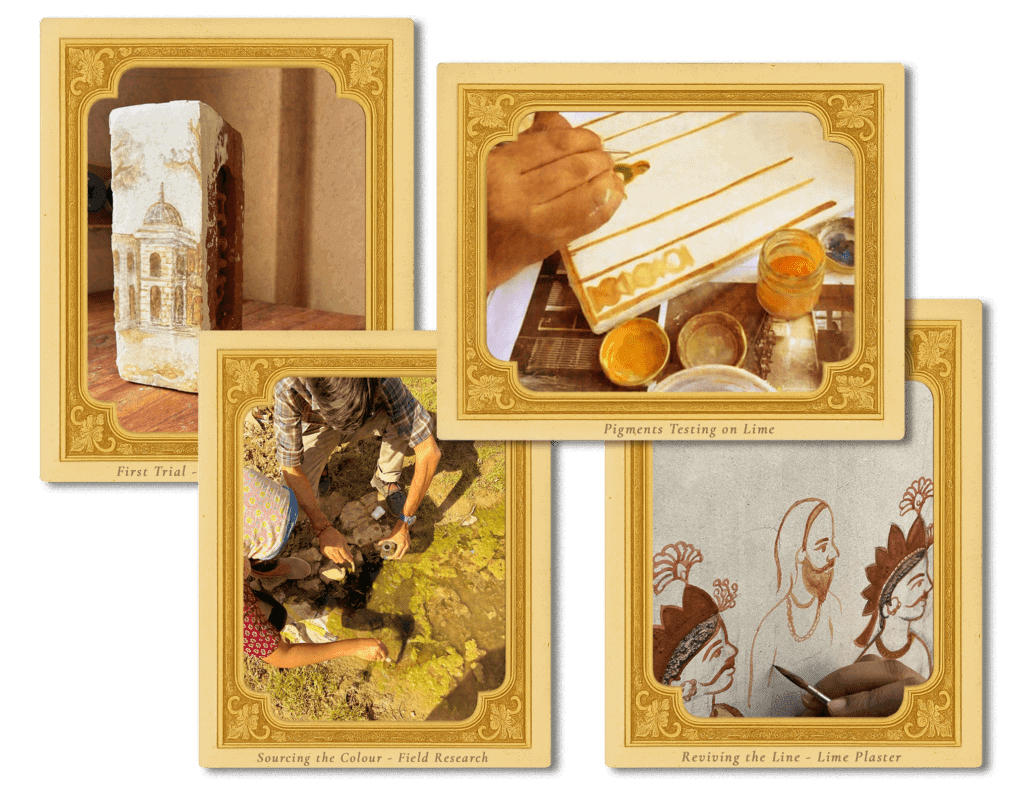
What makes Kamangiri technically extraordinary is the process. The walls were prepared with care, multiple layers of lime plaster, smoothed and refined. The final layer had to be painted while still damp. There was no room for error. The pigments were natural, extracted from stones, turmeric, flowers, and soil, ground and prepared before each session, and sealed into the surface through gentle burnishing. This is a fresco tradition in the truest sense. The painting and the wall become one.
This process fell silent around 1900

Why It Stopped
From what we have been able to understand through our research, Kamangiri did not disappear because of a lack of skill or interest. It stopped because its commercial foundation collapsed.
The merchant communities of Kutch, the Bhatias, the Jains, the great trading families who commissioned these walls, began migrating out of Kutch in significant numbers. As they left, so did the patronage. Without commission, without walls to paint, the art quietly paused. It was never formally declared over. It simply had no more reason to continue.
Today, there are a handful of people, perhaps two or three, who still practise something connected to Kamangiri. But they work on canvas and cloth, with synthetic materials. The original practice, lime plaster, natural mineral pigments, wet-surface painting, has not been passed on. The knowledge of the material itself was lost with the last generation that worked in it.
This is what we are trying to change.

A Conversation That Changed the Research
One of the most significant moments in this research came not from a wall or a building, but from a conversation.
Pradip Zaveri from Baroda had personally documented the wall art of Kutch before the 2001 earthquake. When much of what he had photographed was destroyed, his records became some of the only surviving evidence of painted interiors that no longer exist. We were fortunate to speak with him directly, a brief but invaluable exchange that shared knowledge we would otherwise have had no way of finding.
It reminded us that this research is never only about buildings and walls. It is also about the people who noticed, before us, that something important was disappearing — and had the foresight to document it.

The Revival
Simultaneously with the fieldwork, we were working on something that had not been attempted since around 1900, reviving Kamangiri using its original materials. Not as a print. Not as a reproduction on paper or canvas. But as actual artwork made on lime plaster using natural mineral pigments, the way the Kamangars themselves worked.
It took us three years.
Three years of understanding the materials, how lime behaves, how natural pigments extracted from stones, turmeric, and other natural sources sit differently from synthetic colours, how the surface needs to be prepared, how the painting must happen within the window of damp plaster. Three years of failure and adjustment and trying again. Not every pigment cooperated. Some that we know the Kamangars used behave differently on lime today, we are still working through these challenges, one material at a time.
We have now begun making Kamangiri in this original format, working currently in small, collectible forms that carry the same material character, the same pigments, and the same surface as the original wall paintings. The full wall is where this tradition belongs, and that is the direction we are moving towards. But we felt strongly that the revival had to begin with the material itself, not with a shortcut.
Every piece we make today is a step in that journey.
This matters beyond the artwork itself. We believe the only way a tradition like Kamangiri can truly survive is if it finds a place in contemporary life, if people want it, commission it, live with it. We are working on products that carry this material and this story into homes and spaces. Because an art form without commerce has no future. The merchants of Kutch understood this. We are trying to understand it again.
This is the first time Kamangiri has been made in its original lime and mineral format since around 1900. That is not a claim we make lightly. It is the result of three years of research, practice, and a deep respect for what the Kamangars understood about their material.
Why This Matters
The walls we have documented are among the last places where Kamangiri survives in anything close to its original form. Some of the sites we visited are already deteriorating further. The 2001 earthquake destroyed many examples that Pradip Zaveri and others had documented before it. Time, neglect, and renovation are doing the rest.
We didn't know, when we began, that this would take us across Kutch over years of fieldwork, through villages, through forgotten buildings, through history told not in text but in texture. We have learned slowly, from the remnants, from rare photographs, and from people who remembered what time had nearly erased.
There were moments of joy and many of frustration. The materials were hard to source. The results were never guaranteed. But again, and again, the right people crossed our path, and somehow, we kept going. We believe this is more than chance, it is the universe guiding us to listen deeper.
Because Kamangiri is not just pigment on plaster. It is a cultural record. A lived language. A vanishing echo that still lingers in the corners of forts and havelis across Kutc
These walls must be preserved, not just as artwork, but as memory, as voice.
Still Listening
Kamangiri is a vast tradition. What we have shared here is only part of what we have found, and what we have found is only part of what exists. Every visit reveals something new. Every wall has a different story. The more we look, the more we understand how much there is still to understand.
Much of what we know about the Kamangars and their tradition comes from our own fieldwork, our own observation, and the personal narratives shared with us by people across Kutch. This is living research, not a finished account. Some of what we believe today may be refined as we learn more. We share it honestly, in that spirit.
This research is ongoing. We continue to document, to learn, and to share what we discover. There are more walls to visit, more stories to understand, and more of this tradition to bring back into the world.
We are still listening.
If this research resonates with you, if you are a heritage lover, a member of the Kutchi community, or someone who believes this art and these walls deserve a future we would love to hear from you.
Whether through collaboration, contribution, or simply sharing a lead about a building or a painted wall we may not yet have found, every connection moves this work forward.
Write to us at connect@hokutch.com. We are listening.

Explore Field Notes


Explore Field Notes

