

More Than Windows: The Jharokhas That Watched Over Kutch
Nikhil, House of Kutch Studio, Pragmahal, Bhuj Field research: December 2022, March 2025, ongoing

There is something quietly arresting about looking at the world through a jharokha. It is not just a window. It is a frame, of light, of life, of a way of seeing that took generations of craftsmen to perfect. And the more time we have spent looking at jharokhas across Kutch, the more we have come to understand that each one carries within it not just a particular style of carving, but a particular moment in history, of trade, of encounter, of cultural influence that travelled across continents and settled, quietly, into stone and wood.
The jharokha first appeared in our research almost by accident. In August 2023, during an early visit to Rani Vaas within Bhuj's Darbargadh, a structure dating to the 16th century, a lone jharokha caught our attention. Delicate wooden jalis still filtering light like lace, the carved frame holding its form across centuries. It was the kind of detail that stops you and makes you wonder how much care must have gone into a building for even its windows to be made this beautiful. That single jharokha opened a question that has stayed with us ever since.

What a Jharokha Is,
and What It Really Is
What a Jharokha Is, and What It Really Is
In simple terms, a jharokha is a projected window, typically semi-enclosed, cantilevered outward from the face of a building, found across Indian architecture from the medieval period onwards. But that description captures only the structure, not the meaning.
A jharokha is where light and breeze enter a room without fully opening it to the outside world. It is where women of merchant and royal households once observed the street below without being seen. It is where rulers made public appearances to their subjects. It is where artisans, woodcarvers, stonecutters, craftsmen of extraordinary skill, left their most considered work, knowing it would be seen from the lane below every single day.
But the jharokha is also something else, a record of cultural encounter. Kutch was never isolated. It was a trading region with ports that connected it to the Arabian Peninsula, East Africa, the Mughal court, the British colonial administration, and eventually Europe. Every one of these connections left traces in the architecture. The jharokha of Kutch absorbed all of it, Mughal proportions, Rajput ornamentation, British colonial symmetry, European decorative motifs, and made something entirely its own. To look at a jharokha in Kutch carefully is to read, in carved stone and wood, the full story of a region that was always in conversation with the wider world.

December 2022,
A Month of Discoveries
December 2022, A Month of Discoveries
December 2022 was one of the most significant months of our early fieldwork. In a single period of research across Kutch, three locations revealed jharokhas that have stayed with us since.
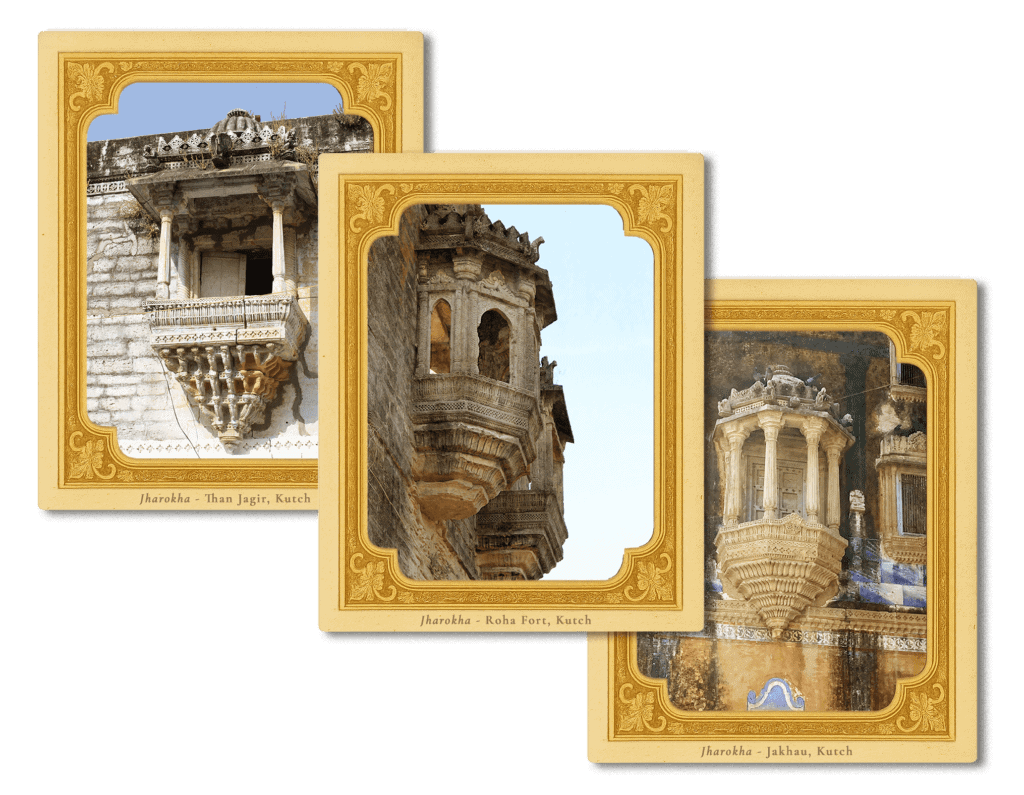
At Roha Fort, bold stone jharokha frames crown the structure, gazing silently over a landscape that has changed enormously around them while they have remained still. Roha is not a place that appears in most accounts of Kutch heritage, which is precisely why it matters. The scale of the carving here is striking. The jharokhas are not decorative gestures. They are confident architectural statements built to last and to be seen, and to make clear that whoever lived within these walls understood the language of power and beauty equally well.
At Than Jagir, a site rarely mentioned even in detailed accounts of Kutch architecture but rich in layers, jharokhas survive amid cracked walls and faded grandeur. The columns below them are heavily carved, the stonework remarkable even in its current state of neglect. Finding something this considered in a place this forgotten is one of the particular pleasures of this kind of research. It is a reminder that the finest work in Kutch was not concentrated only in the famous places.
And then there was Jakhau. We found ourselves on the upper floor of an old building, the floor partly broken, the structure long abandoned, looking out through the carved columns of a jharokha onto the rooftops and lanes of the village below. Red tiled roofs, lime-washed walls, a turquoise window shutter catching the light, narrow lanes running between old houses. The village going about its day, completely unaware of being observed. That view, a decaying frame around a living village, became one of our Heritage Fresco Series pieces. The jharokha was not just a subject of documentation that day. It was the viewpoint itself.
Tera Fort, A Recurring Presence
Tera Fort,
A Recurring Presence
Tera Fort has been part of our research across multiple visits, December 2022, 2023, and 2024. Each time we return, something new reveals itself. The jharokhas here are inseparable from the fort's wider story, the same walls that carry Kamangiri murals in their interior spaces have jharokhas looking outward over the landscape. The painted interior and the carved exterior belong to the same world, the same moment in Kutch's history, the same desire to make even a fortified structure into something of beauty. At Tera, the jharokha and the Kamangiri mural are two expressions of the same sensibility, one looking inward, one looking out.

Devpur Darbargadh, March 2025
Devpur Darbargadh,
March 2025
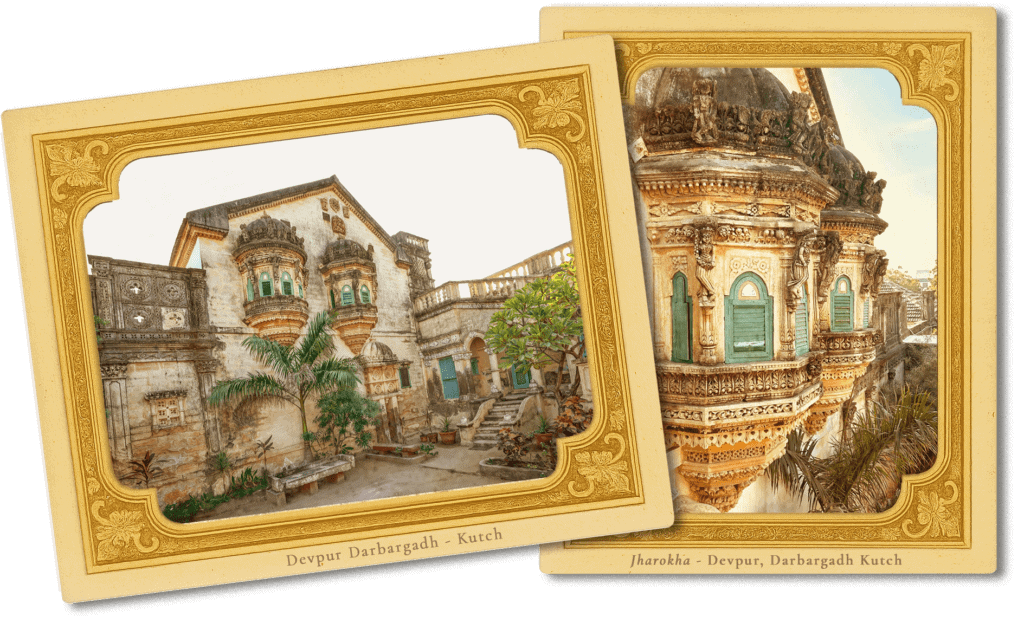
One of the most memorable encounters with jharokhas came during a visit to Devpur Darbargadh in March 2025. The moment you enter, a row of exquisite jharokhas greets you, each one distinct, each one carrying its own character and carving vocabulary. The Devpur Darbargadh still stands with quiet dignity, its royal family having kept the structure alive and open. Spending time there feels like being inside a moment that has somehow refused to end, where the same Kutch light that fell through these jharokhas a hundred years ago still falls through them today, in the same patterns, across the same stone floors.
Fateh Mohammad no Khordo, August 2024
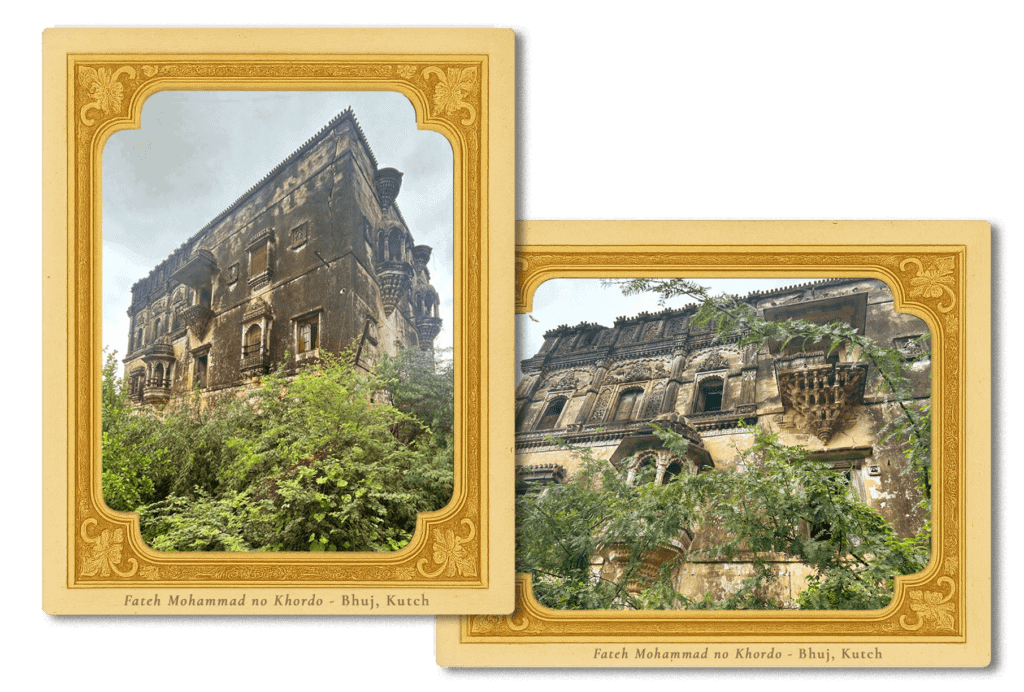
And then there is Fateh Mohammad no Khordo in Bhuj, one of the most quietly extraordinary private heritage homes we have had the privilege of visiting, in August 2024. The Khordo, the residence, belonged to Fateh Muhammad (1752–1813), a Jamadar and regent of Cutch State of Sindhi descent, one of the most significant political figures in Kutch during a period of great turbulence and transition. A man who navigated the decline of Mughal authority, the rise of British influence, and the complex internal politics of the Kutch court, and who built, in Bhuj, a home that reflected all of it.
The jharokhas here are extraordinary, thoughtfully proportioned, carefully carved, carrying in their ornamentation the layered architectural vocabulary that defines Kutch at its most cosmopolitan. This was the residence of a man who spent his life at the centre of power, trade, and cultural encounter. Whether that history shaped the building directly or simply surrounded it, the craftsmanship speaks of a moment when Kutch was absorbing influences from many directions at once, and making something entirely its own.
What Jharokhas Tell Us
Every jharokha we have encountered, at forts, darbargadhs, merchant homes, private residences, carries within it the same essential truth: beauty was not reserved for ceremonial spaces in Kutch. It lived in windows. In carved lattices. In the shadow a jaali throws across a floor on a winter afternoon.
But jharokhas also tell us something about where Kutch was positioned in the world. These are not purely local forms. They carry influences that travelled, from Mughal courts, from Persian architecture, from British colonial design, from European decorative traditions that arrived through trade and through the colonial encounter. The carving vocabulary of a jharokha in a Kutchi Medi can contain, within a single frame, references that span centuries and continents. That is not imitation. That is the architecture of a region that was always in conversation with the wider world, absorbing, adapting, and making something that could only have been made here.
And now, one by one, these windows are closing. Roha Fort, Than Jagir, the Medis of Abdasa, the private homes of Bhuj, all of them carrying jharokhas that have survived earthquakes, neglect, and a century of indifference, but may not survive another generation of demolition and replacement. At House of Kutch, we believe that seeing them carefully, documenting them honestly, and sharing what they carry is the first and most urgent step.
They are the eyes of Kutch's past. Let's not shut them forever.

Explore Field Notes


Explore Field Notes

