

The Fading Legacy of the Medi
Nikhil, House of Kutch Studio, Pragmahal, Bhuj December 2021, ongoing

In December 2021, a journey home changed the way I looked at the land I come from.
I belong to Naliya, a town in Abdasa Taluka, Kutch. But belonging, in my case, is a complicated word.
My great-grandfather left Naliya for Mumbai in the late 1800s, part of the great wave of Kutchi merchant families who moved towards trade, opportunity, and a larger world. He was the first generation to leave. I am the fourth generation to return.
Since childhood, I had come to Naliya every year, to worship our Kuldevi, to reconnect with the place our family had come from. These were familiar visits, rooted in ritual and belonging. Naliya was always there, always waiting.
But December 2021 was different.
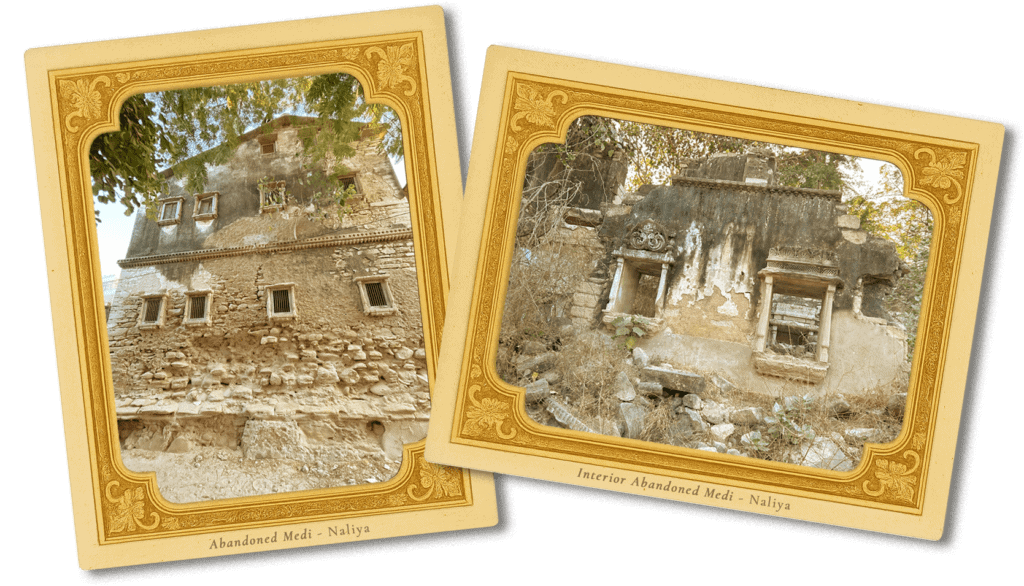
That visit, something shifted in the way I saw the town I thought I knew. I began to notice, for the first time with real attention, what was quietly disappearing around me. One by one, the Medis, those grand, historic bungalows that once defined the landscape of Kutch's merchant towns, were vanishing.
What the Medis Are
What the
Medis Are
The Medi, in Kutchi usage, the elevated upper storey or mezzanine of a traditional merchant home, not a full floor but a raised intermediate space above the ground level where valuables were stored, family quarters kept, and families slept, both for privacy and for the cooler air that height brought, was the architectural expression of a prosperous trading community built between the 18th and early 20th century by families whose prosperity connected Kutch to the wider world.
To stand inside one is to understand immediately that these were people of ambition, taste, and global connection.
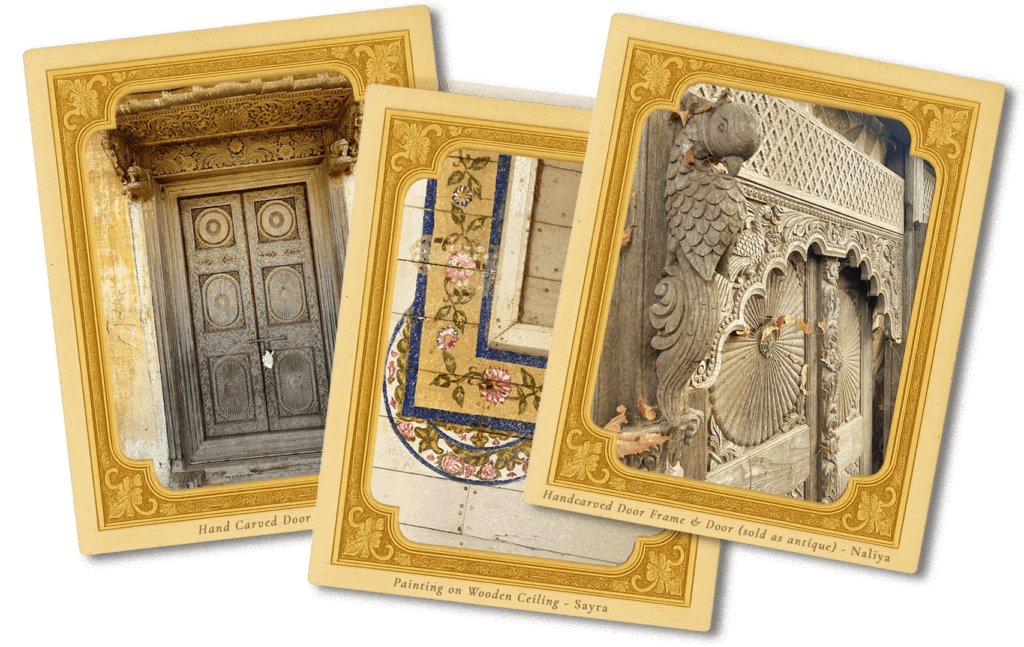
Ornate columns, Italian tiles, Belgian mirrors, intricate jaali work, each element in these homes told a story of a community that sourced materials from across the world and brought them back to a small town in Kutch, because they believed their home deserved nothing less.
These were the homes of families like mine.

What I Found
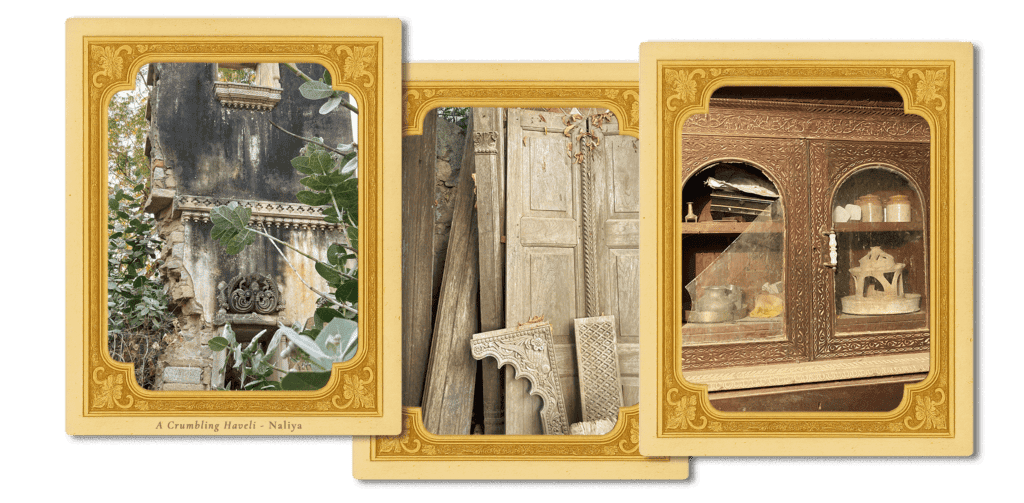
Some Medis were being sold. Others demolished. I learned that after the walls were brought down, the carved wooden windows, the age-old doors, the elegant furniture, many pieces over 150 years old, were being sold off to antique dealers. What once stood as a proud reminder of a luxurious lifestyle and a prosperous past was being dismantled, bit by bit.
Many structures were damaged during the 2001 earthquake. Others have simply been abandoned, left to decay under harsh sun and silence. As families migrated for better livelihoods, these architectural gems were left without caretakers, their relevance fading with each passing year.
And yet some Medis survive. A few have been cared for, preserved by families who understand their worth, not just in material value, but as pieces of a shared past. In villages across Abdasa, these bungalows still stand, whispering tales of how rich and vibrant life once was. Villages across the Kutch region hide similar forgotten gems, many just as grand, and just as fragile
There was a particular weight to seeing this as someone whose own family was part of that merchant world. My great-grandfather left Naliya and built a life in Mumbai. He was not alone, thousands of Kutchi merchant families made the same journey, drawn by trade and opportunity. As they left, the homes they built began to empty. The craftsmen who painted their walls had no more walls to paint. The traditions that had flourished under their patronage quietly fell silent.
The departure of the merchants did not just change Kutch economically. It changed it culturally, in ways that are still unfolding.
The Research That Followed
What began as a personal observation in December 2021 became something larger. From 2022 onwards, we have been travelling across Kutch, documenting Medis, merchant homes, forts, darbargadhs, and the material world that these buildings once carried within them.
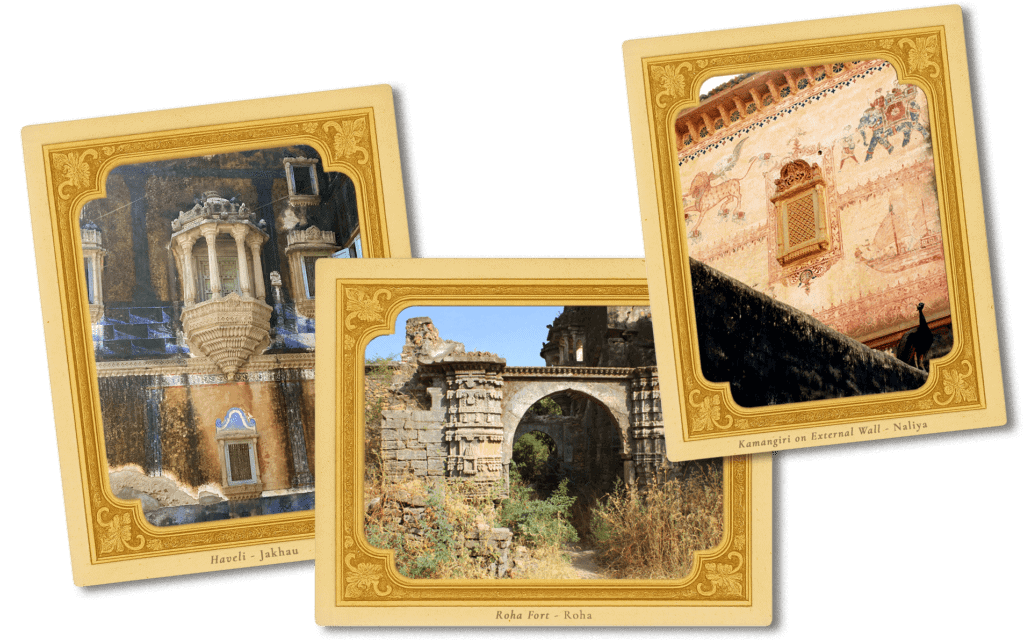
The more we looked, the more connections emerged. The same merchant families who built the Medis were also the patrons of Kamangiri, the nearly lost tradition of decorative wall painting that once lived on the interior walls of these very homes. To document a Medi without understanding Kamangiri is to see only half the picture. And to revive Kamangiri without understanding the Medi is to miss the context in which it was ever truly at home.
For me, this research is not only about heritage. It is also about understanding the world my great-grandfather left, what it looked like, what it felt like, what it valued. The Medis and the Kamangiri murals within them are the closest I can get to that world now.
This research is ongoing. Every visit adds something new, a building, a detail, a fragment of a story not yet told. What we share here is part of an unfolding account, not a finished one.
What Is Being Lost
What happens when the last of them fall? What will we show the next generation? How will we explain the richness of Kutch without these spaces that once gave it form?
It is easy to dismiss these structures as old or inconvenient. But they are the last physical chapters of a remarkable story. To lose them is to lose a living heritage.
These homes carried within them, and across their walls, layers of craft, colour, and tradition that took generations to build. As the buildings come down, those layers come down with them. This is not simply architectural loss. It is the erasure of an entire material and cultural world that cannot be rebuilt once it is gone.
Preserving the Medi is not just about architecture. It is about identity. About pride. About remembering who we are, and where we come from.
Now is the time to act. Before the last doors are shut. Before the stories are sold, piece by piece.
What We Are Doing
I came back to Kutch as the fourth generation of a family that once belonged here. I did not come back to mourn what was lost. I came back to understand it, and to find ways to carry parts of it forward.
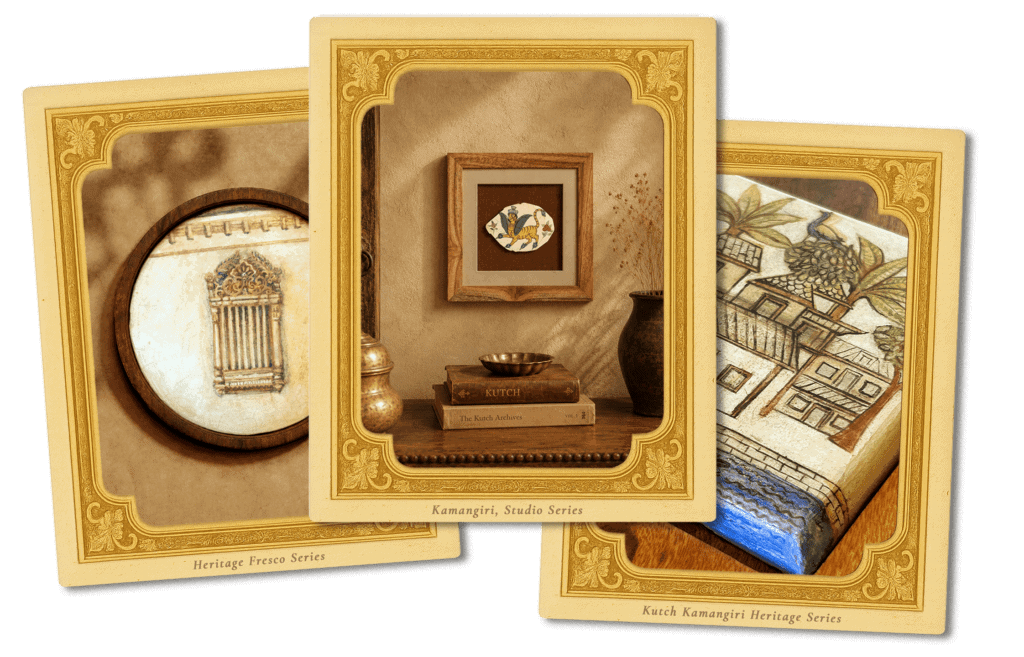
At House of Kutch, our research into Kutch's merchant architecture and the painted traditions that lived within it has directly shaped the work we make. The Heritage Fresco Series, collectible works painted in natural mineral pigments on lime-plaster surfaces, is rooted in specific buildings, specific walls, and specific moments of field documentation across Kutch.
Each piece is our way of holding on to a fragment of what these buildings carried. Not as a reproduction. But as a response, made with the same materials, the same care, and the same understanding of what was once here.
If this resonates with you, if you are a member of the Kutchi community, a heritage lover, or someone whose family once lived in or owned a Medi, we would love to hear from you.
If you know of a Medi that deserves to be documented, preserved, or simply seen before it is too late, write to us. If you are a family that wants their home recorded as part of this ongoing research, we welcome that conversation.
Every Medi has a story. We would like to hear yours.
Write to us at connect@hokutch.com. We are listening.
Explore Field Notes


Explore Field Notes

